In today’s evolving cybersecurity landscape, Managed Service Providers (MSPs) face increasing pressure to offer robust security solutions without the massive overhead of building their own Security Operations Center (SOC). The answer lies in White Label SOC integration—a turnkey approach that empowers MSPs to deliver enterprise-grade cybersecurity under their own brand while leveraging a trusted SOC partner’s infrastructure, expertise, and tools.
This comprehensive guide provides a step-by-step roadmap for MSPs integrating a White Label SOC, from planning and vendor selection to deployment and optimization.
What Is a White Label SOC?
A White Label SOC (Security Operations Center) is a managed cybersecurity service operated by a third-party provider but branded and delivered by an MSP as their own. It enables MSPs to offer 24/7 threat detection, incident response, and monitoring without investing in the cost, technology stack, or personnel required to run a full-fledged SOC.
By integrating a White Label SOC, MSPs gain access to advanced SIEM (Security Information and Event Management) tools, threat intelligence platforms, and security analysts while maintaining complete control over customer experience and communication.
Why MSPs Need White Label SOC Integration ?
Cyberattacks on SMBs have surged, and clients now expect their MSPs to provide proactive cybersecurity protection.
However, setting up an in-house SOC requires millions in investment, constant staffing, and advanced tooling.
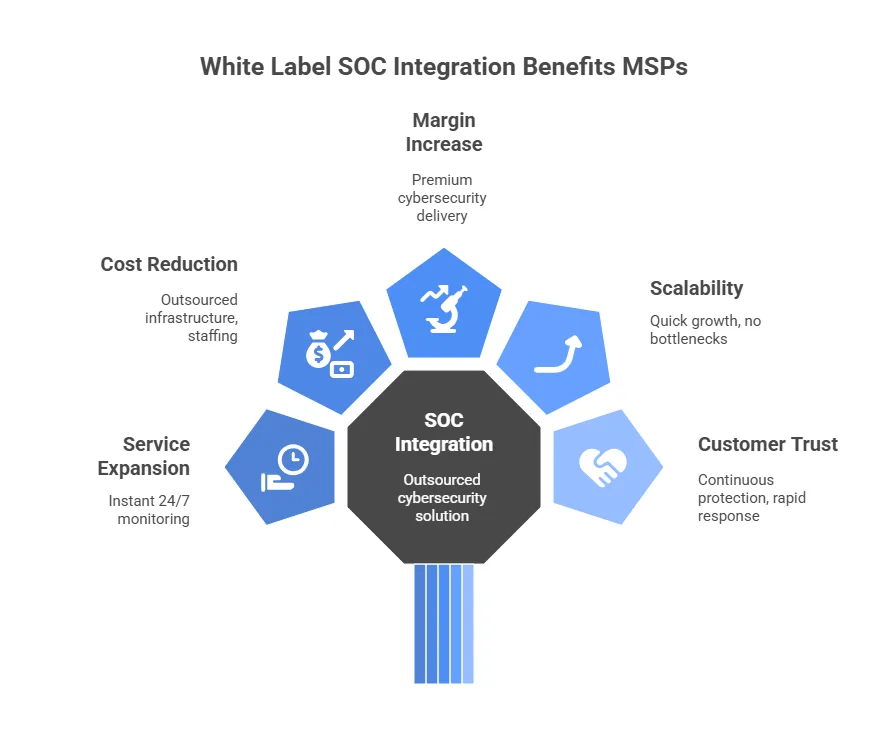
A White Label SOC integration helps MSPs to:
Expand service portfolios instantly with 24/7 monitoring.
Reduce costs by outsourcing infrastructure and staffing.
Increase margins by delivering premium cybersecurity under their own brand.
Scale quickly without operational bottlenecks.
Enhance customer trust through continuous protection and rapid response.
Step 1: Assess Your Business Needs and Readiness
Before integrating a White Label SOC, an MSP must conduct a comprehensive readiness assessment. Determine:
Which security services you plan to offer (SIEM monitoring, incident response, vulnerability management, etc.).
What your current capabilities are in terms of personnel and technology.
The target industries or compliance requirements (e.g., HIPAA, GDPR, PCI DSS) of your clients.
Your desired level of integration and control—from co-managed SOC to fully outsourced.
This assessment clarifies scope, defines KPIs, and sets the foundation for a seamless SOC integration strategy.
Step 2: Select the Right White Label SOC Partner
Choosing the right partner is the most critical step in the process. The ideal White Label SOC provider should align with your business model, client needs, and scalability goals.
When evaluating providers, consider:
Proven SOC expertise in your target market.
24/7 monitoring capabilities across time zones.
Technology stack compatibility, including SIEM, EDR, MDR, and SOAR tools.
Transparency and reporting models—the ability to deliver branded dashboards and reports.
Flexible engagement models (per device, per endpoint, or per customer).
Compliance certifications (ISO 27001, SOC 2 Type II, GDPR-ready).
Look for a partner that emphasizes collaboration, scalability, and brand invisibility, allowing you to present the service entirely as your own.
Step 3: Define Service Scope and Integration Framework
Once the SOC partner is selected, define the service framework. This involves mapping out roles, responsibilities, and deliverables for both parties.
Key areas to define include:
Scope of coverage: What assets, networks, and endpoints are monitored.
Incident escalation protocols: Who responds first, and how alerts are handled.
Communication workflows: How tickets and reports are managed.
Data ownership and privacy: Ensure full data transparency and compliance with client regulations.
SLAs and performance metrics: Establish clear KPIs for uptime, response times, and detection accuracy.
A structured framework ensures smooth collaboration and minimizes ambiguity throughout the engagement.
Step 4: Technical Integration and Platform Configuration
With service definitions in place, begin technical integration. This is where the White Label SOC connects seamlessly with your MSP’s existing systems and processes.
Typical integration tasks include:
Connecting SIEM systems for log collection and event correlation.
Deploying sensors or agents on client networks for endpoint monitoring.
Integrating ticketing systems (like ConnectWise, Autotask, or ServiceNow) to automate workflows.
Setting up dashboards and reporting under your brand.
Testing alert mechanisms and escalation processes to ensure accuracy.
A well-executed integration results in real-time visibility, automated detection, and synchronized incident response—essential for efficient SOC operations.
Step 5: Branding and White Label Customization
White Label SOC services are only as valuable as the perception of ownership you create for your clients. Customize the SOC deliverables to reflect your MSP’s branding.
Implement:
Branded reporting templates and dashboards.
Custom email domains for alerts and communications.
Co-branded portals where clients can view incident summaries and threat reports.
Consistent tone and messaging across all SOC communications.
This approach strengthens customer loyalty while reinforcing your brand’s authority as a trusted cybersecurity partner.
Step 6: Onboarding Clients to the New SOC Service
After technical setup, focus on smooth client onboarding. Create a detailed onboarding plan covering:
Initial environment assessments and risk mapping.
Deployment of monitoring tools and endpoint sensors.
Defining escalation procedures and communication hierarchies.
Educating clients on SOC capabilities and value propositions.
A well-structured onboarding process ensures that every client experiences immediate value, reducing churn and maximizing satisfaction.
Step 7: Continuous Optimization and Reporting
SOC integration is not a one-time event—it’s an ongoing partnership. Regular optimization is essential to maintain performance, detect evolving threats, and improve client outcomes.
Focus on:
Weekly and monthly reporting with actionable insights.
Threat intelligence updates to enhance detection accuracy.
Performance reviews with the SOC provider to refine workflows.
Proactive tuning of SIEM rules and detection logic.
By maintaining a feedback loop, MSPs can continuously elevate service quality, reduce false positives, and strengthen client trust.
Step 8: Scaling and Expanding Services
Once the foundation is strong, leverage your White Label SOC to expand service offerings and boost profitability.
Consider adding:
Advanced threat hunting and forensic analysis.
Compliance management and audit-ready reports.
Managed detection and response (MDR) capabilities.
Cloud security monitoring for hybrid environments.
This layered approach transforms your MSP from a traditional IT provider into a fully managed cybersecurity partner, unlocking higher margins and long-term client retention.
Benefits of White Label SOC Integration for MSPs
By implementing a White Label SOC, MSPs gain:
Instant access to enterprise-grade cybersecurity infrastructure.
Faster time-to-market for new security services.
Reduced operational burden and improved efficiency.
Enhanced client retention through proactive threat mitigation.
Greater profitability and scalability with minimal capital investment.
With the right SOC partner, MSPs can confidently expand into cybersecurity without compromising on quality or control.
Integrating a White Label SOC is one of the most strategic moves an MSP can make to future-proof its business. With the right partner, clear framework, and structured implementation, MSPs can deliver 24/7 cybersecurity protection, increase client trust, and scale operations profitably—all under their own brand.
In a world where cyber threats evolve by the minute, the value of continuous protection cannot be overstated. A well-integrated White Label SOC isn’t just an operational enhancement—it’s a competitive advantage.
Sreekanth
Technical and Professional Services Manager
Sreekanth is the Technical and Professional Services Manager at Secucenter. With over 12 years of expertise in safeguarding IT infrastructures across on-premises, hybrid, and cloud environments, he is dedicated to enhancing security measures. His innovative mindset drives him to develop robust and resilient cybersecurity frameworks.
Sreekanth is the Technical and Professional Services Manager at Secucenter. With over 12 years of expertise in safeguarding IT infrastructures across on-premises, hybrid, and cloud environments, he is dedicated to enhancing security measures. Sreekanth's innovative mindset drives him to develop robust and resilient cybersecurity frameworks.
White Label SOC Integration: Step-by-Step Implementation Guide for MSPs
In today’s evolving cybersecurity landscape, Managed Service Providers (MSPs) face increasing pressure...
Oct 30, 2025 |
Jan 22, 2026
|
12 min
|
8.4k views
In-House SOC vs. White Label SOC: What’s Right for Your MSP?
In today’s cyber landscape, Managed Service Providers (MSPs) face constant pressure to...
Oct 28, 2025 |
Jan 22, 2026
|
12 min
|
8.4k views
Top 10 Benefits of Partnering with a White Label SOC Provider
In today’s fast-paced cybersecurity landscape, Managed Service Providers (MSPs) face mounting pressure...
Frequently Asked Questions
Common Questions
Typical onboarding is 5–10 days from signed contract to live 24×7 coverage. API integrations so your EDR, IdP, cloud and SIEM happen in the first 48 hours; tuning and baselining takes the rest of the first week.
Yes. All analysts operate under strict access controls, SOC 2 Type II-audited infrastructure, and data residency guarantees. We handle PII under GDPR, HIPAA, and regional equivalents depending on your jurisdiction.
The free security audit covers attack surface mapping, a review of your current tool coverage, identification of critical visibility gaps, and a prioritised remediation roadmap delivered within 5 business days.
Absolutely. We're SIEM-agnostic and have pre-built connectors for Splunk, Microsoft Sentinel, Elastic, QRadar, and Sumo Logic. Custom integrations are handled during the onboarding sprint at no extra cost.
Every alert, response action, and investigation is logged with full chain-of-custody. Reports are generated monthly in formats accepted by SOC 2, ISO 27001, HIPAA, NIST CSF, and PCI-DSS auditors.
Standard engagements run 12 months with a 30-day written notice exit clause. Month-to-month options are available for organisations that need flexibility before committing to an annual term.
Stop guessing where you're exposed.
Talk to a senior analyst this week.
Most breaches begin with a gap no one was watching. Tell us what you're protecting and our SOC analysts will pressure-test your defenses and show you exactly where you stand.
Level 17, TransAsia Cyber Park Kochi, Kerala-682030
Data privacy notice.
All submissions are protected via TLS 1.3 encryption in transit and
processed within our secure, air-gapped data environment. We never resell your data.







 For active security incidents only.
 Nov 11, 2025
  Jan 22, 2026
 12 min
 8.4k views